Three Tables, One Paragraph: Back-Cover Copy for the Phone-Lit Reader
Photo: Jerónimo Roure, CC BY-SA 4.0, via Wikimedia Commons
Time was when a blurb had one job and one setting. A reader picked up the book, turned it over, and stood at a table in a shop with the thing in their hands. Everything about the copy was designed for that moment: the width of the paragraph, the size of the type, the amount of white space around it.
That reader still exists, though they are now in a minority. Today the same paragraph must survive on a retailer's product page, where it sits beneath a thumbnail and above a delivery estimate; it must survive as a screenshot forwarded between two friends on a Tuesday evening; and it must survive in the handful of characters a bookseller can quote on a hand-written card. The words have not changed. The conditions have.
The three places a back cover is now read
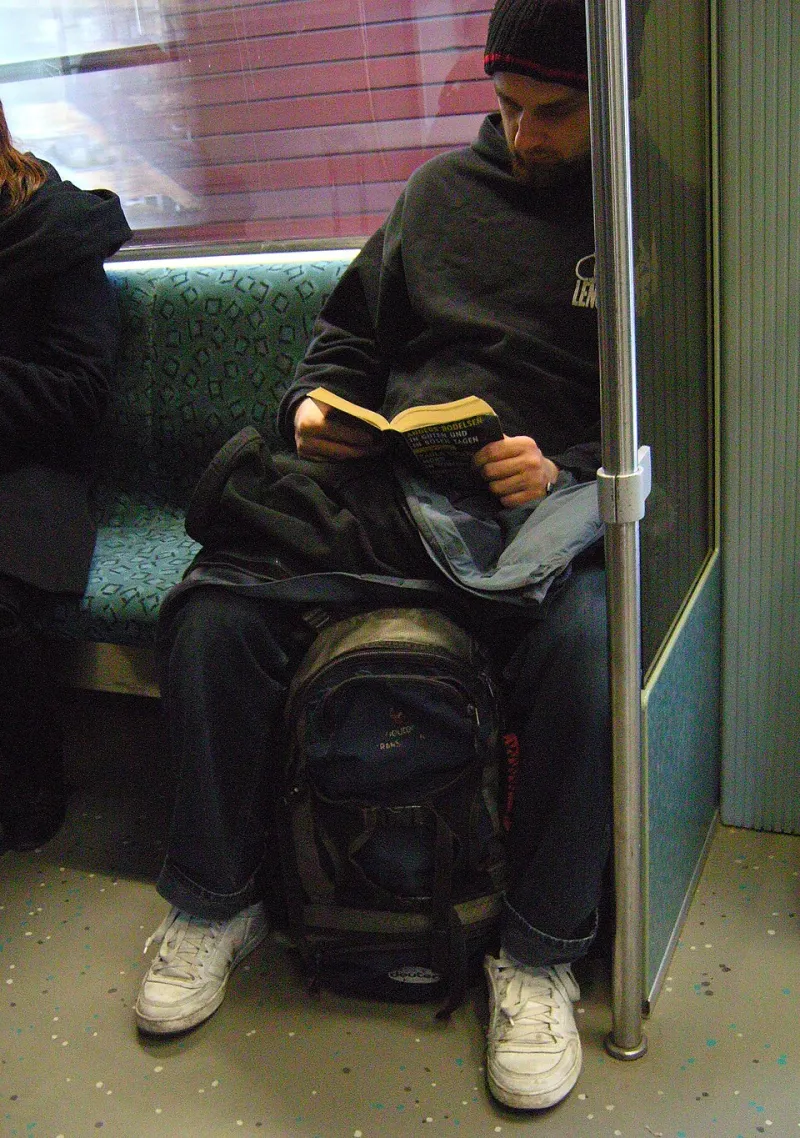
Consider a reader on the train from Bristol to Paddington. A friend has sent them a photograph of a book they thought would suit. The photograph includes the cover, part of a coffee cup and the back cover at a slight angle. Our reader squints at it, decides within four seconds whether to look the book up, and forgets it entirely if that decision is not easy.
Consider the same reader in a bookshop on a Saturday, holding the book at arm's length because they are standing in an aisle and cannot get closer to the light. They will read the first sentence and, if it holds them, the last. The middle will go unread.
Consider them again at home, reading the same copy in a narrow column between two advertisements, with eleven reviews above it.
Three settings, three reading behaviours, one paragraph. The blurb that works in all three is the one that has been written for none of them exclusively.
Naming the reader out loud
The first job is naming. Not naming the audience in a marketing sense — not "for fans of self-help" — but naming the reader's situation in a way that produces recognition. There is a difference between a book that is "for anyone who wants to grow" and one that says, in effect: this is for the person who has read a great deal and changed very little.
The test is straightforward. Read your opening line to someone who has not read the manuscript and ask them who it is for. If they answer with a demographic, the line is too broad. If they answer with a description of a person — a colleague, a season of life, a particular kind of stuckness — it is working.
Making one promise, not several
Second job: the promise. Personal growth books are unusually prone to promising everything, because their authors genuinely believe the material can help in many directions. A blurb that lists five benefits, however, delivers none of them. The reader's eye has nowhere to settle.
Better to make a single promise with a shape to it: a change from one state to another, described in the plainest language you can manage. Where the manuscript makes several arguments, choose the one that governs the rest, and let the sample pages do the persuading.
Sounding like the book
Third job, and the one most often lost in the queue for approval: the blurb must sound the way the book sounds. A book written in measured, unhurried prose should not be sold in exclamation marks. A book of practical exercises should not be described in abstractions.
One way to check is a reading test. Take a paragraph at random from chapter three and read it directly before reading your blurb aloud. If the two voices could belong to different authors, revise the blurb rather than the chapter.
A routine for testing
The following takes an afternoon and will save months.
First, the arm's length test. Print the blurb at the size it will appear on the back cover and pin it to a wall. Stand two metres away. Whatever you cannot read, or cannot be bothered to read, is too long.
Second, the screenshot test. Photograph the copy on a phone in ordinary indoor light and look at it on the screen at normal size. If a sentence wraps awkwardly or the paragraph becomes a grey block, shorten the sentences.
Third, the forty-word test. Distil the blurb into forty words — the length a bookseller might write on a card, or a friend might type into a message. If you cannot do this without losing the point, the point is not yet clear.
Fourth, the stranger test. Give the blurb, with no cover and no title, to three readers who do not know your work. Ask two questions: what is this book about, and would you read it? Their answers will tell you whether the promise arrived intact.
What to leave off
Resist the testimonial that says nothing, the comparison to a book that is nothing like yours, the adjective that could apply to any volume on the shelf, and the summary of the whole book including its ending. The blurb is not a synopsis. It is the opening of a conversation, and it needs to leave the reader something to do.
Do that — name the reader, make the promise, sound like the book — and the paragraph will hold its shape on the shop table, in the listing and in the photograph. Which is, in the end, the whole of its second job.